LP Smart Siding vs James Hardie: What Swelling Looks Like and Why We Install Hardie Only
If you're comparing LP Smart Siding with James Hardie fiber cement, here is what we tell homeowners and why we only install one of them.
October 13, 2026 · 4 min read
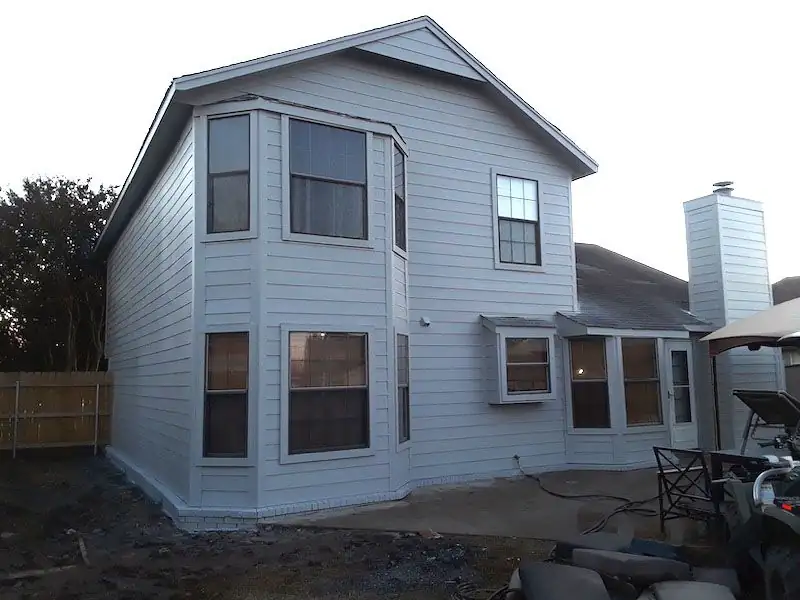
Sooner or later, every homeowner who gets a few siding quotes runs into the same question. One contractor pitches LP Smart Siding, another pitches James Hardie fiber cement, and the price difference looks small enough that it's tempting to pick based on whoever shows up on time. It's a fair question, and it deserves a straight answer.
At Oklahoma Siding, we exclusively install James Hardie siding. We've done it since Mike Ross started the company in 2012, and we've finished over 70 homes with it. So we're not a neutral party, and we won't pretend to be. What we can do is explain what we've seen, what we tell customers, and what to look for on your own house.
What the two products are made of
James Hardie fiber cement is a blend of cement, sand and cellulose fibers, pressed into planks. It's a masonry-style material that is cut, hung and painted like wood siding, but it does not behave like wood. LP Smart Siding is an engineered wood product, which means wood strands and binders at its core. That difference in raw material is where almost every other difference starts.
Wood-based materials take on moisture and give it back. Cement-based materials mostly don't. That is the whole story in one sentence, and the rest of this article is about what it means once the siding has been on your house for a few years.
What swelling looks like
Here's how we answer the question on our own FAQ page: LP Smart Siding swells from collecting water over the years. James Hardie siding is impervious to water, fire and animals, it holds paint better, and we think it looks better on your home. That is our experience and our opinion, and we stand behind it.
So what does swelling actually look like when you walk around a house? It rarely shows up as one dramatic failure. It starts small, usually in places where water sits or gets in:
- Bottom edges of planks that look thicker or rounder than the rest of the board, especially near the ground, a patio, or a downspout.
- Cut ends and nail holes that look puffy, dark or rough instead of crisp.
- Paint that bubbles, peels or flakes in one spot while the rest of the wall looks fine.
- Seams that have opened up or planks that no longer sit flat against the wall.
- Soft or crumbly texture when you press a thumb or a screwdriver tip against the plank.
None of these signs prove a product failed on its own. Poor flashing, a missing drip edge, a sprinkler that hits the wall every morning and skipped caulking can cause the same symptoms on almost any siding. But if you see several of them on a wall that has no obvious leak, the material itself is worth questioning.
Why paint holds better on fiber cement
Paint wants a stable surface. When a plank takes on water, it moves a little, and the paint film on top has to stretch and shrink with it. Over a few seasons the film cracks and lets in more water, and that's the loop that ends in peeling. A cement-based plank is far steadier, so the paint on it has a much easier time staying where you put it.
That is why we say Hardie holds paint better, and it's a practical point, not a marketing one. Repainting is the recurring cost of owning a house with siding. If the surface underneath keeps the paint attached longer, you spend less time and money on touch-ups. It also helps the house keep looking the way it did the day the crew drove away.
Why we install Hardie and nothing else
We could carry several brands, and plenty of contractors do. We chose not to. When one crew installs one product over and over, they get very good at it. They know how the planks cut, where the trim details need extra attention, which fasteners and caulks suit it, and what a clean finished wall should look like. We call ourselves elite premier installers of James Hardie siding because that's the only thing we hang.
We also honor the manufacturer's warranties, and on top of that we give our own 5-Year Craftsmanship Warranty on our work. The manufacturer covers the product, and we cover how it went on your house. If you're comparing quotes, ask every contractor who covers what, and get the answer in writing.
Questions to ask any siding contractor
- Which exact product are you quoting, and which profile and thickness?
- What happens at the bottom course, around windows, and where the siding meets trim?
- Who backs the product, and who backs the labor? For how long?
- Will you show me finished homes you've done with this product, not just photos from the factory?
- Are you insured, and can I see proof?
Checking your own house
If you already have LP Smart Siding or any other siding and you're not sure about its condition, walk the house on a dry day. Start at the bottom edge of the walls and look closely at the lowest course, then check around windows, doors and the corners. Press gently on any spot that looks dark or puffy. If it feels soft, take a photo and keep going.
Oklahoma Siding serves Tulsa, Broken Arrow, Wagner County, Catoosa, Fair Oaks, Glenpool, Jenks and Oakhurst, and estimates are free. If you'd like a second set of eyes on your walls, call (918) 223-3987 or text (918) 704-0942. We'll tell you what we see, even if the answer is that your siding is fine for now.
Oklahoma Siding, (918) 223-3987
Call (918) 223-3987More articles
What Happens During a Siding Replacement, Step by Step
A siding replacement is less mysterious once you know the order the work happens in, so here is the job from first scrape to final walk-around.
Five Signs of Wood Rot on Trim, Fascia and Soffits
Rot on exterior wood usually announces itself well before it becomes a big repair, if you know where to look and what to press on.